If your website is not accessible, you are not just excluding users with disabilities. You are leaving revenue, trust, and competitive advantage on the table. Research shows that 70% of ecommerce sites have accessibility barriers that prevent people from completing purchases. With over one billion people globally living with a disability, representing a market worth hundreds of billions of dollars, ignoring accessibility is not a moral oversight. It is a significant business risk with real financial consequences.
For businesses investing in web design Melbourne and broader digital strategy, accessibility is one of the highest-leverage improvements available. And yet most sites are still built for an imaginary average user, one who has perfect vision, full motor control, fast internet, and a desktop browser. That user does not exist. Inclusive web design is about building for everyone who does.
Key Takeaways
- 70% of ecommerce sites have accessibility barriers that block purchases. That is not a compliance gap. It is a direct revenue gap that Melbourne businesses can close.
- Over one billion people globally live with a disability. The accessible market is not a niche. It is one of the largest and most underserved customer segments online.
- Call-in support costs up to 15x more than a completed digital transaction. Accessible design reduces operational overhead while improving the customer experience.
- 86% of consumers prefer brands that cater to all users. Inclusive web design is a trust signal as much as it is a technical standard.
- Accessibility best practices including semantic HTML, descriptive alt text, and clear heading structure overlap directly with SEO. Building accessible is building smarter.
What Is Inclusive Web Design?
Inclusive web design goes far beyond ticking compliance checkboxes. It is a strategic, user-centred approach to building digital experiences that serve the widest possible audience: across abilities, ages, languages, cultures, and even temporary limitations like a broken arm or reading a screen in harsh sunlight.
Web accessibility focuses specifically on ensuring websites meet technical standards such as the Web Content Accessibility Guidelines (WCAG 2.1). Inclusive design takes a broader view. It combines those technical standards with usability, empathy, and genuine consideration for the full diversity of your audience, ensuring your website is not just technically compliant but genuinely welcoming to every visitor.
The distinction matters. A standard website is built for the average user. An inclusive website is built for everyone: people with disabilities, older users, non-native speakers, and those accessing your site on a slow mobile connection in a busy environment. Barriers to access can be physical, cognitive, sensory, or technological. Inclusive design removes them before they are encountered.
Why Accessibility Is a Business Issue
Businesses that treat accessibility as a compliance task rather than a growth strategy are missing the point on both counts. The financial case is straightforward once you look at the numbers.
Lost Revenue and Market Share
If users cannot register, browse, or complete a purchase due to accessibility barriers, they leave. Studies estimate that inaccessible websites cost businesses billions of dollars annually in lost transactions. For Melbourne ecommerce businesses, even small friction points during checkout can significantly increase cart abandonment. The accessible market is not a small niche. It is one of the most underserved customer segments on the web, and the ecommerce businesses that remove these barriers first gain a meaningful competitive advantage.
Higher Operational Costs
When users cannot complete tasks independently online, they call. Digital transactions cost around $0.50 each. Call-in transactions can cost upwards of $7.50. For businesses fielding significant support volume, that gap compounds quickly. Accessible design is not just good UX. It is cost reduction at scale.
Legal and Compliance Risk
Lawsuits over inaccessible websites are increasing globally. The landmark Domino's Pizza case in the US established that businesses can be held liable for inaccessible digital content even without explicit local legislation. In Australia, the Disability Discrimination Act applies to online services, and government accessibility requirements are tightening. Building accessibility in now is significantly cheaper than retrofitting under legal pressure later.
Reputation, Trust, and Brand Loyalty
Consumers are increasingly values-driven in their purchasing decisions. Surveys show that 86% of consumers prefer companies that cater to all users, and 64% are willing to invest in brands that demonstrate genuine inclusivity. An accessible website signals respect and social responsibility, qualities that translate directly into customer loyalty and stronger long-term brand perception for Melbourne businesses competing in crowded markets.
SEO and Organic Performance
Accessibility best practices and SEO best practices overlap significantly. Descriptive alt text on images, semantic HTML structure, proper heading hierarchy, and text transcripts for media all help search engines better understand and index your site. For Melbourne web design projects we build, accessibility improvements consistently contribute to better organic search performance. The two disciplines reinforce each other.
A Framework for Inclusive Web Design
Accessible, inclusive websites are built on two complementary frameworks: the Seven Principles of Inclusive Design and the POUR accessibility model from WCAG 2.1. Together, they provide both the strategic philosophy and the practical implementation standards.
The Seven Principles of Inclusive Design
Flexibility: Offer alternatives to accommodate different user needs. This includes video transcripts, multiple navigation methods (keyboard, mouse, touch), and adjustable font sizes.
Simplicity: Prioritise clarity and essential features. Avoid clutter and complex interactions that may overwhelm users, particularly those with cognitive impairments.
Consistency: Keep navigation and interactions predictable across all pages. Consistent layouts, labels, and controls help users build confidence and reduce cognitive load.
Perception: Use diverse content formats such as text, visuals, and audio to convey information. Ensure sufficient colour contrast and never rely on colour alone to communicate meaning.
Equity: Ensure every visitor can complete tasks without friction, regardless of their abilities or devices. This includes full keyboard accessibility and reliable screen reader support.
Prevention: Design to reduce errors. Form elements should have descriptive labels, real-time validation, and clear correction guidance.
Accommodation: Use layouts, language, and imagery that reflect and welcome your diverse audience. Avoid stereotypes and respect cultural and linguistic differences across your user base.
The POUR Accessibility Framework (WCAG 2.1)
Perceivable: Content must be presented in ways all users can perceive. This includes alt text for images, captions for video, and sufficient colour contrast ratios.
Operable: Navigation and interactive elements must work with different inputs, including keyboard-only navigation. Avoid keyboard traps and provide visible focus indicators.
Understandable: Information and interactions must be clear and predictable. Use plain language, consistent navigation patterns, and error prevention techniques.
Robust: Content must work reliably with current and future assistive technologies. Follow semantic HTML and ARIA standards to ensure broad compatibility.
Best Practices You Can Start With Today
Accessibility improvements do not always require a full rebuild. Many of the most impactful changes are straightforward, cost-effective, and improve the experience for every user, not just those with disabilities.
- Add transcripts and closed captions: essential for hearing-impaired users, useful in noisy environments, and a direct SEO benefit.
- Write descriptive alt text for all images: allows screen readers to interpret visuals and provides fallback content when images fail to load.
- Use semantic heading structure: helps both screen readers and search engines understand your content hierarchy.
- Maintain high colour contrast: improves legibility for low-vision users and makes pages easier to read on mobile in bright light.
- Enable full keyboard navigation: critical for users with mobility impairments and beneficial for power users who prefer not to reach for a mouse.
- Add clear, associated form labels: reduces confusion for assistive technology users and cuts form abandonment for everyone.
- Test across devices, browsers, and assistive tools: real-world testing with screen readers and keyboard-only navigation surfaces issues automated tools miss.
A useful rule of thumb: if a change makes your site easier to use for someone with a disability, it almost certainly makes it easier for everyone else too. Accessibility and usability are not competing goals. They are the same goal.
How Pinecone Agency Builds for Everyone
At Pinecone Agency, accessibility is not an audit we run at the end of a project. It is built into our design and development process from day one. Every website we build in Melbourne is designed with clarity, consistency, and inclusivity as foundational principles, not optional extras.
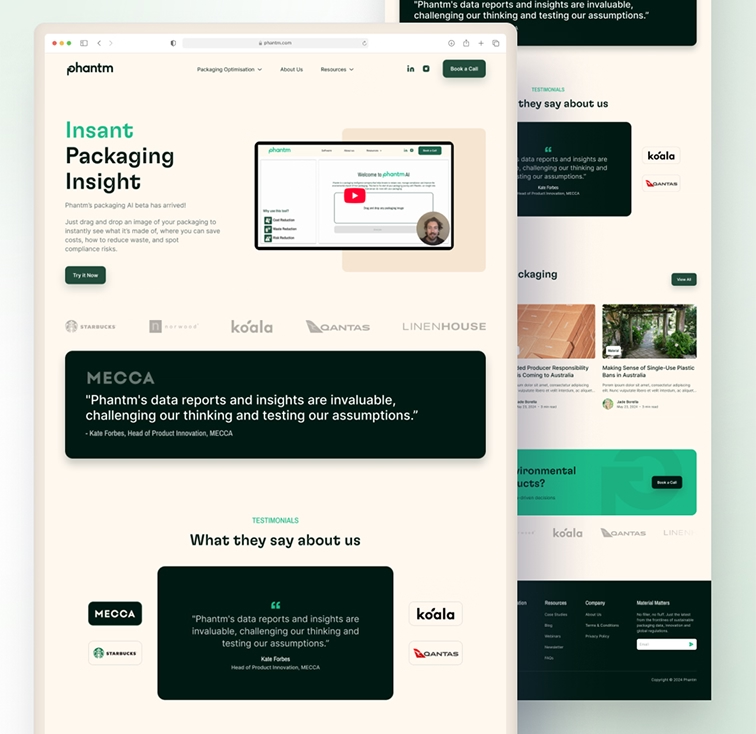
Our Webflow development expertise allows us to build WCAG-aligned sites that are fast, clean, and conversion-optimised. We test with assistive technologies, including screen readers and keyboard navigation, to ensure real-world accessibility rather than just technical compliance. You can see this approach reflected in projects like Phantm and Forget Me Not, where accessible, user-centred design was built into the brief from the start.
For Melbourne businesses across retail, professional services, ecommerce, and technology, our web design agency in Melbourne brings inclusive design principles to every project. It is an opportunity to expand reach, reduce risk, and build a digital presence that genuinely serves every customer. A website that works for everyone is a website that converts for everyone.
Build for Growth. Build for Everyone.
Inclusive web design is not just about compliance. It is about building digital experiences that welcome all users, strengthen your brand, and unlock markets your competitors are ignoring.
Whether you are redesigning an existing site or building from scratch, our digital agency Melbourne team brings accessibility, performance, and strategy together in every project. From small business website design in Melbourne to complex ecommerce and web application development, we build sites that work for every customer, on every device, in every context.
Ready to make your website truly inclusive? Talk to our Melbourne web design team.

.avif)
.avif)
.avif)
.avif)
.avif)