"
Pinecone Agency redesigned and rebuilt our website at a critical juncture for our business, delivering outstanding results that were fantastic value for money. They exceeded our expectations with their incredible attention to detail, technical expertise, and seamless processes. The entire experience was enjoyable, and the team was responsive, knowledgeable, and professional throughout. The SEO results are already being felt, and the site is easy to update and add content to. We couldn't be happier with the final product and highly recommend Pinecone to anyone, especially businesses starting out or in the early stages. They'll give you everything you need to establish your business.
"
Matt Kendal
"
Pinecone is a helpful agency so far, they made my website so professional and grow up my sales
"
Ryan Morse
"
Pinecone redid our company website and it was a truly seamless, collaborative, and fun process! Our website is beautiful, functional, and already generating more business. I could not recommend Pinecone enough! Richard and the team are simply the best.
"
Jenny Collins
"
We had an outstanding experience working with Pinecone Agency on our recent Webflow project, with Richard as our point of contact. The team was fairly priced, demonstrated excellent communication throughout the process, and delivered everything on time. Richard's professionalism and reliability made the entire experience seamless, and we're thrilled with the final result. Highly recommend Pinecone Agency for anyone needing a top-notch Webflow project!
"
Spencer Bunting
"
Our website is beautiful, functional, and already generating more business. I could not recommend Pinecone enough! Richard and the team are simply the best.
"
Sydney Ward
"
We had an amazing experience working with Pinecone Agency! They were very responsive, professional and the end product is great. They really listened to what we needed and made it happen. Highly recommend.”
"
Nadia Estrada
Marketing
02 April 2026
1 mins read

What Is Answer Engine Optimisation (AEO)? The Complete Guide for 2026

Search is no longer about ranking, it's about being the answer. This guide breaks down Answer Engine Optimisation (AEO), what it is, how AI platforms like ChatGPT and Google Gemini choose their sources, and what Melbourne businesses need to do now to stay visible in a world where most searches never result in a click.

What Is Answer Engine Optimisation (AEO)? The Complete Guide for 2026

Search is no longer just about ranking. It is about being the answer. In 2026, AI-powered platforms like ChatGPT, Google Gemini, and Perplexity AI have fundamentally changed how people find information. Instead of returning a list of links for the user to click through, these platforms synthesise content from across the web and deliver a single, direct response. If your brand is not being cited as a source in those responses, you are losing visibility to competitors who are.

This is the shift that answer engine optimisation (AEO) addresses. It is one of the most important emerging disciplines in digital marketing, and Melbourne businesses that get ahead of it now will have a significant advantage. At Pinecone Agency, we work at the intersection of web design, technical SEO, and AI-readiness. This guide covers everything you need to know about answer engine optimisation Melbourne businesses and brands across Australia need to start showing up in the places your audience is actually searching.

Key Takeaways

  • AEO is the practice of structuring your content so AI platforms select it as a cited source when answering user queries, not just a ranked link in a results list.
  • Over 60% of Google searches now end without a click to an external site. However, visitors who do arrive via an AI citation convert at 14.2%, which is 23 times the rate of traditional organic traffic.
  • Answer engines prioritise semantic completeness, E-E-A-T authority signals, and entity consistency. Generic content that repeats what everyone else has published will not be cited.
  • Technical readiness matters more than ever. Fast load times, structured data (schema markup), and server-side rendering all affect whether AI crawlers can access and trust your content.
  • For Melbourne businesses, AEO is especially powerful for local services. Being cited as the answer to queries like 'best web design agency in Melbourne' is worth more than a traditional top-10 ranking.

What Is Answer Engine Optimisation?

Answer engine optimisation is the practice of structuring and enhancing digital content so that AI-powered search platforms select it as a cited source when generating real-time responses to user prompts. Unlike traditional search engine optimisation, which focuses on ranking a web page within a list of results, AEO focuses on the answer-retrieval layer: ensuring that when an AI engine needs a source for a specific fact, definition, or recommendation, your content is the one it uses.

The distinction matters because the user journey is completely different. In traditional SEO, the path is: search, click a result, read the page. In AEO, the path is: ask a question, receive a synthesised answer. Your brand either appears in that answer or it does not. There is no page two. This is why generative engine optimisation (GEO) and AEO have quickly moved from niche concepts to core strategy for any digital agency serious about long-term visibility.

The primary goal shifts from driving traffic to becoming the cited authority. Success is no longer measured in clicks and impressions, but in citation share and Share of Model (SoM), which tracks how often your brand appears in AI-generated answers relative to competitors.

The Numbers That Should Change How You Think

By early 2026, over 60% of all Google searches in major markets end without a single click to an external site. When AI Overviews are present, that zero-click rate climbs to an estimated 83%. In Google AI Mode, it reaches 93%. Analysts have called this the 'Great Decoupling': search query volume keeps growing while referral traffic to external websites declines.

This might sound like bad news, but there is a critical counterpoint. The quality of traffic that does emerge from answer engines is dramatically higher. Research indicates that AI-referred visitors convert at a rate of 14.2%, which is 23 times higher than traditional organic search visitors. The reason is that answer engines perform the early-stage research and filtering for the user, only referring them to a source when they are ready to engage deeply or transact. This has significant implications for conversion rate optimisation strategy: fewer but far more qualified visitors.

The business impact is structural. Gartner's projection that 25% of organic search traffic would shift to AI chatbots and virtual assistants by 2026 has materialised. Brands are now forced to measure Share of Model rather than Share of Voice, tracking how an AI model represents them relative to competitors, not just how often they appear in traditional media.

How Answer Engines Choose Their Sources

To succeed at AEO, you need to understand what AI systems are actually evaluating. Unlike traditional search algorithms that rely heavily on the link graph and backlink authority, answer engines are focused on the Knowledge Graph and semantic completeness. Selection is governed by factual density, structural clarity, and verifiable authority.

Semantic completeness is the leading ranking factor in 2026, with a correlation of r=0.87 to selection in AI Overviews. Answer engines prioritise 'answer islands': standalone passages that fully resolve a user's query without requiring them to read the entire article. If a website simply summarises the same five tips found on every other site, an AI agent has zero incentive to cite it. To win a citation, content must provide what researchers call 'N=1' data: proprietary insights, a unique conceptual framework, or a specific case study. Content scoring above 8.5 out of 10 in semantic completeness is 4.2 times more likely to be cited by a generative engine.

Entity intelligence also plays a major role. Answer engines have shifted from keyword matching to entity understanding, evaluating the connections between concepts. High 'Entity Knowledge Graph Density', having 15 or more connected entities recognised by major databases, shows a 4.8 times higher selection probability. For a Melbourne digital agency, this means ensuring your brand, your team, your services, and your clients are all consistently described and connected across the web.

E-E-A-T (Experience, Expertise, Authoritativeness, and Trustworthiness) has moved from a qualitative guideline to a quantitative signal. Critically, branded web mentions, even without a hyperlink, now have a much stronger correlation (0.664) with appearing in AI answers than traditional backlinks (0.218). AI models learn a brand's value from how it is talked about across the web: in reviews, in discussions, in expert commentary.

What Your Website Needs to Do Differently

AEO requires changes at both the technical and content levels. On the technical side, the focus shifts from human usability toward 'machine-readability' and 'agent eligibility.' A key development in 2026 is the adoption of the llms.txt file, a new protocol designed specifically for large language models. Unlike robots.txt, which tells crawlers what not to access, llms.txt provides an intelligent, structured summary of your site's most authoritative content, guiding AI models toward the specific information they should use for synthesis. Any business working with a technical SEO specialist should be asking about this.

Structured data through Schema.org has become the cornerstone of AEO. It provides a machine-readable layer that explicitly defines the entities and relationships on a page. Beyond basic Article schema, advanced practitioners implement @graph arrays in JSON-LD, declaring interconnected entities (Organisation, Person, WebPage, FAQ) to build a coherent semantic graph. Page speed is also a direct factor. AI crawlers are computationally expensive to run, so they prioritise sites that deliver structured information quickly. Targets to aim for include a Largest Contentful Paint under 1.2 seconds and a Time to First Byte under 200ms. Server-side rendering is strongly preferred over client-side JavaScript rendering, which some bots cannot process at all.

At the content level, the 2026 strategy is governed by the 'Bottom Line Up Front' (BLUF) structure. AI engines prioritise direct, concise answers that can be easily extracted and repurposed into summaries. Each section of an article should be treated as a standalone information island. A practical tactic is the 'Answer Capsule': a concise definition or direct resolution of 40 to 60 words placed immediately after a question-based heading. This format aligns with the extraction patterns of both featured snippets and AI summaries.

Building the Authority That AI Trusts

Answer engines are fundamentally risk-averse. They are designed to find and prioritise trusted sources to minimise hallucinations. This means your brand's reputation across the entire web matters, not just on your own site. For SEO services in the AEO era, public relations has effectively become a technical SEO task. Securing coverage in high-authority media now functions as a citation signal that outweighs legacy link-building tactics.

For local service businesses in Melbourne and across Australia, the AEO version of “local SEO Melbourne” is keeping your business details consistent everywhere locally. AI search optimisation for local queries requires a different approach to traditional directory listings. This means your business name, address, and phone number (NAP details) must be consistent and accurate everywhere. Your Google Business Profile, local directory listings, and website must all describe the same entity in the same way. LocalBusiness schema with localised FAQs strengthens your eligibility for locally-intent queries. AI search is narrowing the visibility radius to micro-markets, making proximity signals and consistency more critical than ever.

Demonstrating human expertise is equally important. As AI-generated content becomes a commodity, the Experience signal in E-E-A-T has become a primary differentiator. Answer engines look for phrases like 'In our testing' or 'We discovered that' to identify original, human-led research. Content attributed to a subject-matter expert with real credentials and verifiable institutional affiliations consistently outperforms anonymous or generic brand content.

How to Measure AEO Success

Traditional metrics like average rank and website sessions are insufficient for measuring AEO impact. Success in 2026 is defined by Share of Model (SoM) and the Citation Gap, which measures the space between where a brand should appear as a trusted source and where it actually appears in AI-generated answers.

The AI Visibility Score (AVS) is the practical tool for tracking this. It involves compiling 20 to 30 core commercial and informational queries, running these monthly across ChatGPT, Gemini, Perplexity, and Bing Copilot, and recording the percentage of times your brand or URL is explicitly cited. Tracking the trend direction over 90-day periods gives you a clear picture of whether your AEO efforts are gaining ground. Marketers should also track the 'Halo Effect': users who see a brand cited in a ChatGPT comparison and later search for that brand directly or visit the site via a navigational query, even without clicking through from the AI answer itself.

What This Means for Melbourne Businesses

For businesses in Melbourne competing for high-intent local queries, the AEO opportunity is significant and largely untapped. When someone asks ChatGPT 'who is the best web design agency in Melbourne' or 'which digital agency in Melbourne specialises in Webflow', the brands that appear in that synthesised answer are not necessarily the ones with the most backlinks. They are the ones whose content is structured, authoritative, and semantically complete.

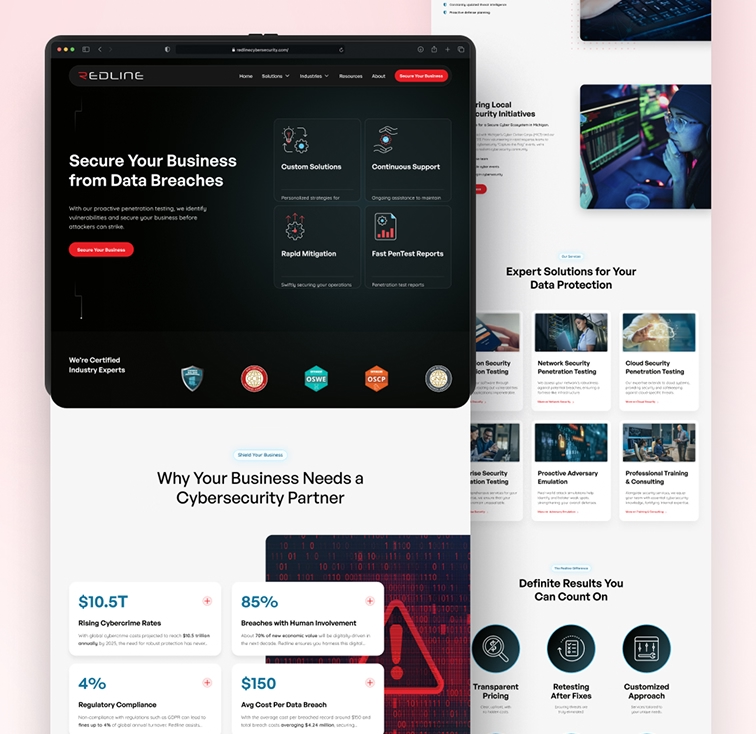
At Pinecone Agency, we build websites and digital strategies that are designed for both human audiences and AI agents. See how we have approached this for clients like Redline Cyber Security and Filenote AI. That means fast, server-side-rendered sites with structured data, clear entity definitions, and content that answers real questions with genuine depth. The same principles that make a site great for local SEO in Melbourne are the foundation of strong AEO: consistency, authority, and relevance.

If you want to understand where your brand currently stands in AI-generated answers, or you want to start building a strategy to improve your answer engine optimisation in Melbourne, get in touch with our team. In 2026, search is no longer about finding a website. It is about becoming the answer.


Conclusion

For businesses in Melbourne competing for high-intent local queries, the AEO opportunity is significant and largely untapped. When someone asks ChatGPT 'who is the best web design agency in Melbourne' or 'which digital agency in Melbourne specialises in Webflow', the brands that appear in that synthesised answer are not necessarily the ones with the most backlinks. They are the ones whose content is structured, authoritative, and semantically complete.At Pinecone Agency, we build websites and digital strategies that are designed for both human audiences and AI agents. See how we have approached this for clients like Redline Cyber Security and Filenote AI. That means fast, server-side-rendered sites with structured data, clear entity definitions, and content that answers real questions with genuine depth. The same principles that make a site great for local SEO in Melbourne are the foundation of strong AEO: consistency, authority, and relevance.

Pinecone Team
The Pinecone Agency Marketing Team represents a focused, research-led approach to content creation, grounded in hands-on experience across strategy, SEO, and digital growth. Each piece is carefully developed through in-depth research and real project insights, ensuring clarity, relevance, and performance. The work centres on creating purposeful content that supports brand visibility and measurable outcomes.

Free Website Audit Guide

Review your site in 15 minutes with a simple and free checklist.

  • 5-second homepage test
  • Printable scorecard
  • No tech skills needed
Thank you! Your submission has been received!
Oops! Something went wrong while submitting the form.
Simple. Helpful. Zero filler.

Words from our partners

Beautiful Websites!

We had an amazing experience working with Pinecone Agency! They were very responsive, professional and the end product is great. They really listened to what we needed and made it happen. Highly recommend.”

Beautiful Websites!
Nadia Estrada
Nadia Estrada

Beautiful Websites!

Our website is beautiful, functional, and already generating more business. I could not recommend Pinecone enough! Richard and the team are simply the best.

Beautiful Websites!
Sydney Ward
Sydney Ward

Good Process!

We had an outstanding experience working with Pinecone Agency on our recent Webflow project, with Richard as our point of contact. The team was fairly priced, demonstrated excellent communication throughout the process, and delivered everything on time. Richard's professionalism and reliability made the entire experience seamless, and we're thrilled with the final result. Highly recommend Pinecone Agency for anyone needing a top-notch Webflow project!

Good Process!
Spencer Bunting
Spencer Bunting

Good Partner!

Pinecone redid our company website and it was a truly seamless, collaborative, and fun process! Our website is beautiful, functional, and already generating more business. I could not recommend Pinecone enough! Richard and the team are simply the best.

Good Partner!
Jenny Collins
Jenny Collins

More like this Article

Explore more insights to help you grow online.

How to Migrate Your Website in 8 Proven Steps (Without the Stress)
Development
All
Featured
Development
Technology
How to Migrate Your Website in 8 Proven Steps (Without the Stress)

Moving your website doesn't have to mean downtime, traffic losses, or post-launch chaos. Follow these 7 steps to migrate with a clear plan, protected SEO, and zero nasty surprises.

Website migrations have a reputation, and it is not a flattering one: slow timelines, broken pages, and traffic drops that take months to recover. But here is the truth. It does not have to be that way.

Whether you are moving to a new platform, changing domains, or upgrading your infrastructure, the key is not perfection. It is preparation. The more thought you put in upfront, the smoother the transition will be. For Melbourne businesses investing in a website redesign, a well-managed migration is one of the clearest signs of a well-built digital operation.

At Pinecone Agency, we have guided countless migratiWebsite migrations have a reputation, and it is not a flattering one: slow timelines, broken pages, and traffic drops that take months to recover. But here is the truth. It does not have to be that way.

Whether you are moving to a new platform, changing domains, or upgrading your infrastructure, the key is not perfection. It is preparation. The more thought you put in upfront, the smoother the transition will be. For Melbourne businesses investing in a website redesign, a well-managed migration is one of the clearest signs of a well-built digital operation.

At Pinecone Agency, we have guided countless migrations for Melbourne businesses, from small business website development and ecommerce storefronts to complex web application development projects. As a Webflow agency and website redesign company, we have seen what works, what breaks, and what separates a smooth launch from a stressful one.

Here is our practical, step-by-step guide to getting your website from Point A to Point B, without the chaos.

Key Takeaways

  • Back up everything before you touch anything. Databases, files, configurations, and content. This is not optional and it must happen first.
  • A content audit before migration is the difference between a clean new site and one that carries forward broken, duplicate, or outdated pages.
  • Treat your URLs like assets. A proper 301 redirect map preserves years of SEO equity. Pointing everything to the homepage is one of the most damaging migration mistakes a business can make.
  • DNS cutover is the moment your live domain points to the new site. It requires careful timing, pre-configured TTL settings, and a clear rollback plan if something goes wrong.
  • The difference between a smooth migration and a chaotic one is almost always the team behind it. Specialists who have done this hundreds of times prevent the costly mistakes DIY teams discover too late.

Step 1: Back Everything Up

Before a single file moves, a single setting changes, or a single redirect is added, back up everything. This is not a step you can defer to later in the process. It is the very first thing you do.

A complete backup means your databases, images, videos, documents, plugin configurations, CMS content, theme files, and server settings. Everything that would take time or money to reconstruct if it disappeared. Using dedicated backup platforms such as WP Engine or BlogVault makes this process reliable and restorable, not just a static archive you can never actually use.

For Melbourne businesses investing in full-scale web application development or a comprehensive site overhaul, backups protect not just your content but your digital marketing history, your SEO performance data, and your business continuity. Migrations go wrong in ways no one predicts. A complete, tested backup means that when something unexpected happens, recovery is measured in minutes, not days.

Do not move to Step 2 until this is confirmed and verified.

Step 2: Start With Clarity, Not Code

Before you brief your development team, get clear on why you are migrating and what a successful outcome looks like. This sounds obvious, but it is the step most often rushed in the excitement to get started.

Are you migrating to improve site performance? Enhance SEO rankings? Simplify content management? Support a full rebrand with modern website design? Each goal calls for different decisions throughout the project. Without clarity upfront, teams end up solving for the wrong things.

Set measurable targets: a 30% reduction in load time, improved conversion rates on key landing pages, or better mobile usability scores. Document your budget, timeline, and who owns each part of the process. A successful migration is not just a technical task. It is a strategic initiative, and getting this foundation right determines the quality of every decision that follows.

Step 3: Audit and Migrate Your Content

One of the most commonly skipped steps in a website migration is a thorough content audit. Moving to a new platform without reviewing what you are bringing across means you risk replicating outdated pages, broken images, duplicate content, and files that should have been retired years ago.

Before migration begins, compile a complete inventory of everything on your current site: all pages, blog posts, landing pages, images, downloadable files, videos, and embedded media. Audit each item against three questions: Is it accurate? Is it still needed? Is it performing? Content that fails these checks should be updated, consolidated, or removed before it ever reaches the new site.

The migration itself requires careful, methodical replication. Every page, image, and file needs to be confirmed as present and loading correctly on the new environment. CMS content structures may differ between platforms, particularly when moving to Webflow development, which means content fields, rich text formatting, and collection structures all need to be mapped and validated individually, not assumed to carry across cleanly.

A content audit also gives you a clean asset list to cross-reference during QA. If you know exactly what should be on the new site, you can verify completeness systematically rather than discovering missing pages weeks after launch when a user reports a broken link.

Step 4: Build a Staging Environment

Think of your staging environment as your website's rehearsal space. It is a complete, working duplicate of your new site where every element can be tested without any risk to your live traffic or current rankings.

In staging, you test everything: layout, navigation, mobile responsiveness, page speed, redirect logic, form functionality, and CMS content accuracy. Mobile users now represent the majority of web traffic for most Melbourne businesses, and responsive web design is not optional. A staging environment is where you confirm that every page looks right across every device before a single visitor sees it.

This step is where professional website redesign services pay for themselves. Catching an error in staging takes minutes. Catching the same error after launch can take days to resolve and weeks to recover from in search rankings. Your staging environment is also where you validate that the new site is SEO-ready, with correct meta tags, structured data, and internal linking confirmed before go-live.

For large sites or those with complex ecommerce functionality, a phased approach is worth considering here. Rather than migrating everything at once, start with a less critical section of the site, validate the process end-to-end, and refine before tackling higher-traffic pages. This reduces the risk of widespread issues and gives your team the opportunity to catch edge cases before they affect your most important pages.

Step 5: Treat Your URLs Like Assets

Redirects are the unsung heroes of any successful website migration. Every URL on your current site carries accumulated SEO value: backlinks pointing to it, crawl history, ranking signals. When that URL changes without a redirect in place, all of that value disappears overnight.

Use tools like Google Search Console and Screaming Frog to audit your existing URL structure before migration begins. Map every old URL to its corresponding page on the new site. Pay particular attention to high-traffic pages and any URLs with strong backlink profiles. These are your most important assets, and they deserve individual attention, not a bulk redirect to the homepage.

Redirecting everything to your homepage is a shortcut that does serious damage. It confuses users, increases bounce rates, and signals to search engines that your site structure has collapsed. A proper 301 redirect map, tested in staging, keeps your rankings stable and your visitors on the right path.

This level of technical SEO rigour is standard practice for any experienced web development company in Melbourne. If your migration partner is not raising redirect mapping in early conversations, treat that as a warning sign.

Step 6: DNS and Domain Cutover

DNS cutover is the moment your live domain stops pointing to the old server and starts pointing to the new one. It is the go-live switch. And it is the step where the most time-sensitive mistakes happen.

Before you make any DNS changes, reduce your TTL (Time to Live) settings to a low value, typically 300 to 600 seconds, at least 24 to 48 hours in advance. TTL controls how long DNS records are cached by servers around the world. A lower TTL means that when you switch, the change propagates faster and your rollback window is shorter if something goes wrong.

When you are ready to cut over, update your DNS records to point to the new hosting environment. This typically involves updating your A record or CNAME to the new server IP or host. Confirm your SSL certificate is active and correctly configured on the new host before switching, as an insecure site immediately after launch damages trust and can trigger browser warnings. Once DNS has propagated, verify the live site across multiple devices, browsers, and locations to confirm it is resolving correctly.

Have a documented rollback plan ready before you begin. If critical issues appear in the first hour after cutover, you need to be able to revert DNS to the old server quickly and cleanly. Define the conditions that trigger a rollback, who has authority to call it, and the exact steps to execute it. This is not pessimism. It is professional risk management.

Once DNS is stable and the new site is confirmed live, submit your updated sitemap to Google Search Console and request a recrawl. This tells search engines to begin re-indexing the new site structure immediately rather than waiting for their regular crawl schedule.

Step 7: Monitor Everything Post-Launch

Your new site is live. The work is not done.

Begin monitoring immediately. Track traffic, bounce rate, conversions, page speed, crawl errors, and uptime using Google Analytics, Google Search Console, and a reliable uptime monitor. These tools surface issues before they have time to affect your rankings or your revenue.

Beyond the data, listen to your users. Are they finding what they need? Is navigation working the way you intended? Are forms submitting correctly? A freshly migrated site is a starting point, not a destination. The businesses that get the most out of their migration are the ones that treat post-launch monitoring as a discipline rather than an afterthought.

Set a review cadence for the first four to six weeks after launch. This is the window where most issues surface, and the faster you catch them, the easier and cheaper they are to resolve. Cross-reference your live site against the content inventory from Step 3 to confirm every page, image, and file is present and loading correctly.

Step 8: Keep Everyone in the Loop

No website migration happens in isolation. Your marketing team, sales team, customer service staff, and leadership all need to know what is changing, when it is happening, and what to expect.

Brief internal teams early. Let them know the timeline, flag any changes to content, forms, or tracking that might affect their workflows, and prepare customer-facing communications for any periods of scheduled maintenance or expected downtime. A heads-up to your audience goes a long way in maintaining trust during the transition.

Internally, document everything. What changed, why it changed, and where future updates will happen. This documentation becomes part of your operational playbook, which is especially valuable if you are working with a Webflow agency in Melbourne on an ongoing basis after launch. Good documentation keeps future iterations faster and less reliant on institutional memory.

Reality Check: Some Dips Are Normal

Even a well-executed migration may produce a short-term dip in traffic or rankings. This is expected behaviour. Search engines need time to re-crawl your site, process your redirects, and re-evaluate your content in its new structure. It is not a sign that something has gone wrong.

Most sites recover within a few weeks, particularly when redirects, page speed, and user experience have all been handled carefully. Keep monitoring, keep working through your post-launch checklist, and resist the urge to make reactive changes before the data stabilises.

The long-term outcome of a well-planned migration is a faster, cleaner, better-optimised site that outperforms what came before. The temporary dip is the cost of getting there properly.

Why a Specialised Team Makes All the Difference

Reading a migration checklist and executing one are two very different things. The gap between them is experience.

A specialised web development team has seen the edge cases. They know that a seemingly minor redirect misconfiguration can wipe out months of SEO gains. They know that a DNS cutover timed incorrectly, or executed without a tested rollback plan, can take a site offline during its peak trading window. They know how to validate a content migration at scale so nothing falls through the gaps. And they know how to manage the dozens of moving parts that a DIY migration treats as an afterthought.

For Melbourne businesses where the stakes are high, whether you are relaunching an ecommerce platform, migrating thousands of URLs, or moving to Webflow from an ageing CMS, attempting this without specialist support is a significant risk. The cost of getting it wrong consistently exceeds the cost of getting it done properly the first time. You can see the kind of work we do for clients like Filenote AI, Nealon Insulation, and SS Engineering to understand the level of care and structure we bring to every project.

Sometimes, peace of mind is the most valuable part of the project.

Migrate With Confidence

Website migration does not need to mean uncertainty, downtime, or traffic loss. With proper planning, a structured process, and an experienced team behind you, it is an opportunity to relaunch stronger than you started.

Whether you are shifting to a new CMS, partnering with a web design Melbourne agency for a full rebuild, or laying the groundwork for long-term growth, the principles are the same: protect what you have built, plan every step, and do not cut corners on the details that matter.

At Pinecone Agency, we do not just migrate websites. As a digital agency based in Melbourne, we help businesses move forward with clarity and confidence. If you are planning a migration and want to get it right the first time, let's talk.

Let's build your next chapter together. Book a free discovery call.

Inclusive Web Design: Making Your Website Accessible to Everyone
Design
All
Design
Webflow
Inclusive Web Design: Making Your Website Accessible to Everyone

Inclusive web design isn't just a legal obligation — it's a growth strategy that expands your market, strengthens your SEO, and builds lasting customer trust. Here's how to build a website that truly works for everyone.

If your website is not accessible, you are not just excluding users with disabilities. You are leaving revenue, trust, and competitive advantage on the table. Research shows that 70% of ecommerce sites have accessibility barriers that prevent people from completing purchases. With over one billion people globally living with a disability, representing a market worth hundreds of billions of dollars, ignoring accessibility is not a moral oversight. It is a significant business risk with real financial consequences.

For businesses investing in web design Melbourne and broader digital strategy, accessibility is one of the highest-leverage improvements available. And yet most sites are still built for an imaginary average user, one who has perfect vision, full motor control, fast internet, and a desktop browser. That user does not exist. Inclusive web design is about building for everyone who does.

Key Takeaways

  • 70% of ecommerce sites have accessibility barriers that block purchases. That is not a compliance gap. It is a direct revenue gap that Melbourne businesses can close.
  • Over one billion people globally live with a disability. The accessible market is not a niche. It is one of the largest and most underserved customer segments online.
  • Call-in support costs up to 15x more than a completed digital transaction. Accessible design reduces operational overhead while improving the customer experience.
  • 86% of consumers prefer brands that cater to all users. Inclusive web design is a trust signal as much as it is a technical standard.
  • Accessibility best practices including semantic HTML, descriptive alt text, and clear heading structure overlap directly with SEO. Building accessible is building smarter.

What Is Inclusive Web Design?

Inclusive web design goes far beyond ticking compliance checkboxes. It is a strategic, user-centred approach to building digital experiences that serve the widest possible audience: across abilities, ages, languages, cultures, and even temporary limitations like a broken arm or reading a screen in harsh sunlight.

Web accessibility focuses specifically on ensuring websites meet technical standards such as the Web Content Accessibility Guidelines (WCAG 2.1). Inclusive design takes a broader view. It combines those technical standards with usability, empathy, and genuine consideration for the full diversity of your audience, ensuring your website is not just technically compliant but genuinely welcoming to every visitor.

The distinction matters. A standard website is built for the average user. An inclusive website is built for everyone: people with disabilities, older users, non-native speakers, and those accessing your site on a slow mobile connection in a busy environment. Barriers to access can be physical, cognitive, sensory, or technological. Inclusive design removes them before they are encountered.

Why Accessibility Is a Business Issue

Businesses that treat accessibility as a compliance task rather than a growth strategy are missing the point on both counts. The financial case is straightforward once you look at the numbers.

Lost Revenue and Market Share

If users cannot register, browse, or complete a purchase due to accessibility barriers, they leave. Studies estimate that inaccessible websites cost businesses billions of dollars annually in lost transactions. For Melbourne ecommerce businesses, even small friction points during checkout can significantly increase cart abandonment. The accessible market is not a small niche. It is one of the most underserved customer segments on the web, and the ecommerce businesses that remove these barriers first gain a meaningful competitive advantage.

Higher Operational Costs

When users cannot complete tasks independently online, they call. Digital transactions cost around $0.50 each. Call-in transactions can cost upwards of $7.50. For businesses fielding significant support volume, that gap compounds quickly. Accessible design is not just good UX. It is cost reduction at scale.

Legal and Compliance Risk

Lawsuits over inaccessible websites are increasing globally. The landmark Domino's Pizza case in the US established that businesses can be held liable for inaccessible digital content even without explicit local legislation. In Australia, the Disability Discrimination Act applies to online services, and government accessibility requirements are tightening. Building accessibility in now is significantly cheaper than retrofitting under legal pressure later.

Reputation, Trust, and Brand Loyalty

Consumers are increasingly values-driven in their purchasing decisions. Surveys show that 86% of consumers prefer companies that cater to all users, and 64% are willing to invest in brands that demonstrate genuine inclusivity. An accessible website signals respect and social responsibility, qualities that translate directly into customer loyalty and stronger long-term brand perception for Melbourne businesses competing in crowded markets.

SEO and Organic Performance

Accessibility best practices and SEO best practices overlap significantly. Descriptive alt text on images, semantic HTML structure, proper heading hierarchy, and text transcripts for media all help search engines better understand and index your site. For Melbourne web design projects we build, accessibility improvements consistently contribute to better organic search performance. The two disciplines reinforce each other.

A Framework for Inclusive Web Design

Accessible, inclusive websites are built on two complementary frameworks: the Seven Principles of Inclusive Design and the POUR accessibility model from WCAG 2.1. Together, they provide both the strategic philosophy and the practical implementation standards.

The Seven Principles of Inclusive Design

Flexibility: Offer alternatives to accommodate different user needs. This includes video transcripts, multiple navigation methods (keyboard, mouse, touch), and adjustable font sizes.

Simplicity: Prioritise clarity and essential features. Avoid clutter and complex interactions that may overwhelm users, particularly those with cognitive impairments.

Consistency: Keep navigation and interactions predictable across all pages. Consistent layouts, labels, and controls help users build confidence and reduce cognitive load.

Perception: Use diverse content formats such as text, visuals, and audio to convey information. Ensure sufficient colour contrast and never rely on colour alone to communicate meaning.

Equity: Ensure every visitor can complete tasks without friction, regardless of their abilities or devices. This includes full keyboard accessibility and reliable screen reader support.

Prevention: Design to reduce errors. Form elements should have descriptive labels, real-time validation, and clear correction guidance.

Accommodation: Use layouts, language, and imagery that reflect and welcome your diverse audience. Avoid stereotypes and respect cultural and linguistic differences across your user base.

The POUR Accessibility Framework (WCAG 2.1)

Perceivable: Content must be presented in ways all users can perceive. This includes alt text for images, captions for video, and sufficient colour contrast ratios.

Operable: Navigation and interactive elements must work with different inputs, including keyboard-only navigation. Avoid keyboard traps and provide visible focus indicators.

Understandable: Information and interactions must be clear and predictable. Use plain language, consistent navigation patterns, and error prevention techniques.

Robust: Content must work reliably with current and future assistive technologies. Follow semantic HTML and ARIA standards to ensure broad compatibility.

Best Practices You Can Start With Today

Accessibility improvements do not always require a full rebuild. Many of the most impactful changes are straightforward, cost-effective, and improve the experience for every user, not just those with disabilities.

  • Add transcripts and closed captions: essential for hearing-impaired users, useful in noisy environments, and a direct SEO benefit.
  • Write descriptive alt text for all images: allows screen readers to interpret visuals and provides fallback content when images fail to load.
  • Use semantic heading structure: helps both screen readers and search engines understand your content hierarchy.
  • Maintain high colour contrast: improves legibility for low-vision users and makes pages easier to read on mobile in bright light.
  • Enable full keyboard navigation: critical for users with mobility impairments and beneficial for power users who prefer not to reach for a mouse.
  • Add clear, associated form labels: reduces confusion for assistive technology users and cuts form abandonment for everyone.
  • Test across devices, browsers, and assistive tools: real-world testing with screen readers and keyboard-only navigation surfaces issues automated tools miss.

A useful rule of thumb: if a change makes your site easier to use for someone with a disability, it almost certainly makes it easier for everyone else too. Accessibility and usability are not competing goals. They are the same goal.

How Pinecone Agency Builds for Everyone

At Pinecone Agency, accessibility is not an audit we run at the end of a project. It is built into our design and development process from day one. Every website we build in Melbourne is designed with clarity, consistency, and inclusivity as foundational principles, not optional extras.

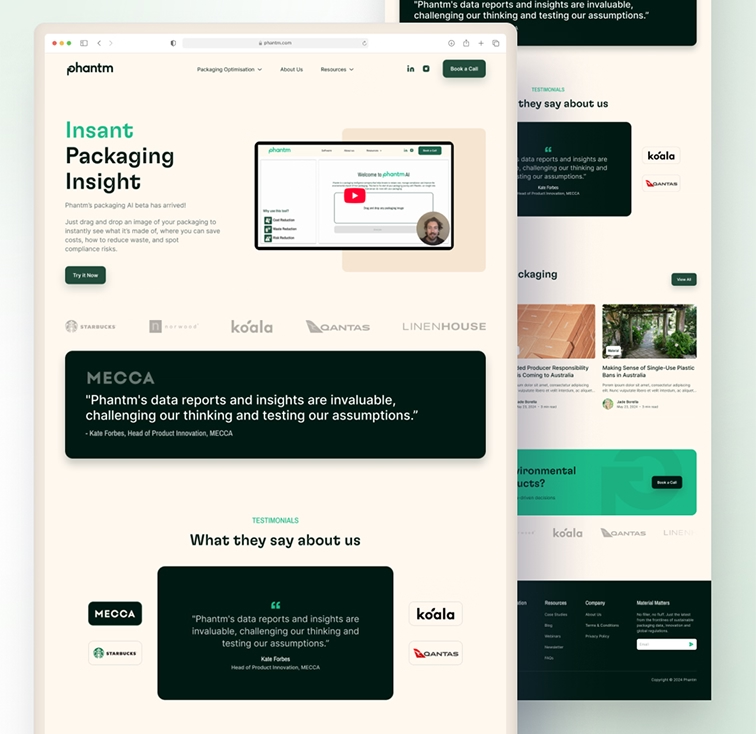
Our Webflow development expertise allows us to build WCAG-aligned sites that are fast, clean, and conversion-optimised. We test with assistive technologies, including screen readers and keyboard navigation, to ensure real-world accessibility rather than just technical compliance. You can see this approach reflected in projects like Phantm and Forget Me Not, where accessible, user-centred design was built into the brief from the start.

For Melbourne businesses across retail, professional services, ecommerce, and technology, our web design agency in Melbourne brings inclusive design principles to every project. It is an opportunity to expand reach, reduce risk, and build a digital presence that genuinely serves every customer. A website that works for everyone is a website that converts for everyone.

Build for Growth. Build for Everyone.

Inclusive web design is not just about compliance. It is about building digital experiences that welcome all users, strengthen your brand, and unlock markets your competitors are ignoring.

Whether you are redesigning an existing site or building from scratch, our digital agency Melbourne team brings accessibility, performance, and strategy together in every project. From small business website design in Melbourne to complex ecommerce and web application development, we build sites that work for every customer, on every device, in every context.

Ready to make your website truly inclusive? Talk to our Melbourne web design team.

How to Optimise Conversion Rates and Accelerate Growth
Marketing
All
Featured
Marketing
Technology
How to Optimise Conversion Rates and Accelerate Growth

Most businesses believe growth begins with more traffic. More ad spend, more content, more campaigns. But the most powerful growth lever is often the one already sitting inside the business: conversions. When you double your conversion rate, you effectively halve your cost per acquisition.

Most businesses believe growth begins with more traffic. More ad spend, more content, more campaigns. But the most powerful growth lever is often the one already sitting inside the business: conversions.

When you double your conversion rate, you effectively halve your cost per acquisition. You get more customers without spending more to reach them. That is the promise of conversion rate optimisation (CRO). It is not about doing more. It is about getting significantly more from what you are already doing.

For Melbourne businesses investing in web design and digital growth, CRO is one of the highest-return strategies available. This guide walks you through how to think about conversion optimisation as a growth multiplier, what to focus on, and how to build a culture of continuous improvement across your site.

Key Takeaways

  • Doubling your conversion rate halves your cost per acquisition. CRO generates compounding returns on traffic you have already paid for.
  • 53% of mobile visitors abandon a site that takes longer than three seconds to load (Google and SOASTA). Speed is not a technical detail; it is a direct revenue lever.
  • Social proof done well can increase conversion rates by up to 270% (Spiegel Research Center, Northwestern University). Reviews and testimonials placed near your CTAs are among the highest-return optimisations available.
  • Personalised CTAs convert 202% better than generic ones (HubSpot, analysis of 330,000+ CTAs). Even basic segmentation based on traffic source or device makes a measurable difference.
  • CRO is not a one-off project. The businesses that compound gains treat it as a continuous discipline: test, learn, apply, repeat.

Why CRO Is the Smartest Way to Scale

Every visitor to your website represents a cost. You have paid for them through SEO, ads, content, or referrals. If they leave without converting, that cost goes unrecovered.

Conversion rate optimisation reclaims that value. Small percentage improvements across your funnel create a compounding effect. A modest increase in landing page conversions or checkout completions can translate to substantial revenue growth over a twelve-month period, without any additional spend on acquisition.

The best part is that you are not starting from zero. You are building on traffic that already exists. For Melbourne businesses running small business website development projects or ecommerce platforms, CRO is the most capital-efficient growth strategy available. You do not need more visitors. You need to convert more of the visitors you already have.

Consider: a service page with a 1% conversion rate that improves to 2% has doubled its output from the same traffic. Multiplied over a year with thousands of visitors, that single change can represent a significant revenue shift.

Small Tweaks, Compounding Results

In web design and development, minor adjustments can drive outsized results. Changing a button colour, rewriting a headline, shortening a form, or reordering a page layout can all meaningfully move conversion metrics.

This iterative approach is central to how an experienced Webflow agency in Melbourne approach growth. Rather than overhauling an entire site and hoping for improvement, the smarter path is to test and validate changes individually. Each experiment produces either a result you can implement or a learning you can build on.

Over time, these small improvements layer on top of each other. A site that has been through twelve months of structured CRO testing outperforms a freshly redesigned site that has never been tested. The compounding effect is the real competitive advantage.

Move Fast, But Let Data Lead

Growth-oriented businesses do not optimise based on gut feel. They use structured testing to iterate with intention. A/B testing is where most CRO programs begin: running two variations of a headline, layout, CTA, or image to see which drives more action. But the best programs do not stop there.

They build a rhythm. Test. Learn. Refine. Repeat. Small experiments gradually inform bigger decisions about messaging, offers, design, and structure. Each test answers one specific question and produces usable data.

At Pinecone Agency, we emphasise data-driven decisions over instinct. Many Melbourne business owners feel confident in their current site design based on familiarity. Without data backing those assumptions, though, there is no way to know what genuinely resonates with your audience. CRO provides that clarity. For digital agency Melbourne clients, this shift from assumption to evidence consistently uncovers opportunities that intuition alone would have missed.

You do not need to overhaul the entire site. Start with one question. Answer it with real data. Then ask the next one.

Design for Humans, Not Just Visitors

At the heart of conversion is user experience. It is not about visual flair. It is about reducing friction. Modern website design built for conversion focuses on simplicity, clarity, and usability. That could mean streamlining navigation, shortening a sign-up form, improving mobile speed, or making a value proposition more immediate and legible.

Speed is a particularly important lever. According to research conducted by Google and SOASTA, 53% of mobile visitors will abandon a site that takes longer than three seconds to load. The same research found that as load time increases from one second to ten seconds, bounce rate increases by 123%. For Melbourne ecommerce businesses and service providers, those numbers translate directly to revenue.

This is why experienced Webflow agencies prioritise performance optimisation alongside visual design. A site can look exceptional but still fail to convert if it loads slowly, navigates awkwardly, or asks users to think too hard about what to do next. Speed, responsiveness, and intuitive structure are not secondary concerns. They are the foundation.

For small business website design in Melbourne, simplifying navigation and reducing page clutter consistently produces measurable conversion improvements. Visitors appreciate a clean, direct path to the information they are seeking. Remove unnecessary steps between intent and action.

Messaging That Matches Intent

One of the most powerful and most overlooked conversion levers is message match. If your ad promises simplicity but your landing page is cluttered and hard to read, users leave immediately. The disconnect between what brought them to the page and what they find there is enough to kill the conversion.

Great conversion messaging aligns headlines, visuals, and copy with the promise that brought the visitor in. Make your value proposition clear within seconds of landing. Put your differentiator front and centre. Use direct, outcome-focused language that tells users exactly what they get and why it matters to them now.

For businesses offering website redesign services in Melbourne, this principle extends across every touchpoint. The experience a user has in your ad, on your landing page, and through your conversion flow should feel consistent and coherent. A cohesive message builds confidence. Inconsistency creates doubt, and doubt kills conversions.

Build Trust Before You Ask for the Sale

No one converts on a site they do not trust. Trust is not built through promises. It is built through proof.

Adding reviews, testimonials, client logos, and real customer outcomes to your site is not just cosmetic decoration. It is a direct conversion strategy. Research from the Spiegel Research Center at Northwestern University found that products with five or more reviews are 270% more likely to be purchased than those with none. Near your primary CTA is where these elements have the most impact.

For emerging Melbourne brands and small businesses, social proof is particularly powerful. A new business with three genuine, specific customer testimonials on a service page will consistently outperform a polished competitor whose site offers no evidence of results. You can see how we approach this with clients like Phantm and Forget Me Not, where strategic social proof placement was built into the design from day one.

Trust also includes the ambient signals of a well-designed site: clean layout, visible contact information, accessible support options, and fast load times. These elements signal legitimacy before a visitor has read a word of your copy.

Personalise Wherever You Can

Generic content converts poorly because it speaks to no one in particular. HubSpot's analysis of more than 330,000 CTAs found that personalised CTAs are 202% more likely to drive conversions than default, one-size-fits-all alternatives.

You do not need complex AI infrastructure to start personalising. Begin with simple segmentation: adjust messaging based on where a visitor came from, the device they are using, or the stage of the buyer journey they appear to be in. Customising the headline for first-time visitors versus returning ones can make a site feel significantly more relevant and trustworthy.

For Webflow development projects in Melbourne, personalisation often starts with tailored landing pages built for specific campaigns or traffic sources. A visitor arriving from a paid ad for a specific service should land on a page that speaks directly to that service, not a generic homepage. The more relevant the experience, the higher the conversion rate.

Forms and CTAs: Less Is Always More

According to Baymard Institute, nearly one in five shoppers abandon a checkout because the process is too long or complicated. Every field you add to a form is a reason for users to reconsider. The same research found that the average checkout process contains nearly 24 form fields, while the optimal number is closer to 12. Keep forms to the minimum required to take the next step. If you do not absolutely need a phone number at this stage of the funnel, do not ask for it.

The same discipline applies to your calls to action. Specificity converts better than vagueness. "Book My Free Consultation" outperforms "Submit." "Get My Custom Quote" outperforms "Send Request." Make it clear what happens when users click, what they receive, and why acting now makes sense.

For website redesign Melbourne projects we work on, form and CTA optimisation is often one of the first areas we audit. The improvements are frequently significant and require no additional design or development work. Just strategic thinking about what you are asking, when you are asking it, and how you are framing the value exchange.

Measure What Actually Drives Growth

Tracking your conversion rate is the starting point, not the finish line. To understand what is driving or dragging performance, you need a fuller picture: bounce rates by traffic source, session duration by device, drop-off points in your funnel, and average order value over time.

These metrics help you diagnose what is working, what is not, and what to test next. The most effective Melbourne businesses treat this like product development: constantly analysing user behaviour, validating assumptions, and testing improvements in a structured sequence.

If you notice a high drop-off rate during checkout, for example, that is not just a number. It is a signal. It tells you where to focus your next experiment, whether that means simplifying the payment process, adding trust signals at the point of purchase, or reducing the number of steps to completion.

Growth compounds when measurement drives action. One well-executed improvement leads to the next. Over time, this discipline is what separates high-performing sites from stagnant ones.

CRO Is a Mindset, Not a Project

Conversion optimisation is not a one-off exercise you complete before moving on. It is the ongoing practice of treating every touchpoint as an opportunity: your landing pages, email sequences, onboarding flows, checkout process, and even your pricing presentation.

The real art of CRO is in building systems. Not just individual tests, but habits. Not just wins, but learnings that inform the next round of experiments. This is where long-term growth lives. A site that has been continuously tested and refined for two years will outperform any freshly launched competitor that has never been tested at all.

Your product can be outstanding. Your marketing can be sharp. But if the conversion experience is not optimised for clarity, speed, and trust, you will consistently leave growth on the table.

Sources

  1. Google and SOASTA, Mobile Site Speed New Industry Benchmarks (2017). Specific to mobile users: 53% of mobile visitors abandon a site that takes over 3 seconds to load; bounce rate increases 123% as load time increases from 1 to 10 seconds.
  2. Spiegel Research Center, Northwestern University, From Reviews to Revenue (2017). Products with five or more reviews are 270% more likely to be purchased than those with none. Lift is higher for premium-priced products (380%) and lower for budget products (190%).
  3. HubSpot, Personalized Calls-to-Action Convert 202% Better Than Basic CTAs (2015, reaffirmed 2025). Based on analysis of over 330,000 CTAs tracked over a six-month period. Improvement is attributed to matching CTAs to buyer journey stage and audience segment.
  4. Baymard Institute, Cart Abandonment Rate Statistics (ongoing). Approximately 1 in 5 shoppers abandon checkout due to an overly long or complicated process. Average checkout contains 23-24 form fields; Baymard recommends reducing to 12-14 for optimal completion rates.

Ready to Level Up Your Conversions?

Pinecone Agency helps growth-minded Melbourne businesses turn their websites and landing pages into high-performing assets through strategic design, structured testing, and continuous optimisation. Whether you are running a website redesign in Melbourne or looking to extract more value from your existing site, we build conversion into everything we do.

From ecommerce conversion optimisation to lead generation for service businesses across Fitzroy, Richmond, South Melbourne, and the CBD, our approach is always the same: data first, design second, results always.

Let's turn your existing traffic into measurable growth. Book a free discovery call.